

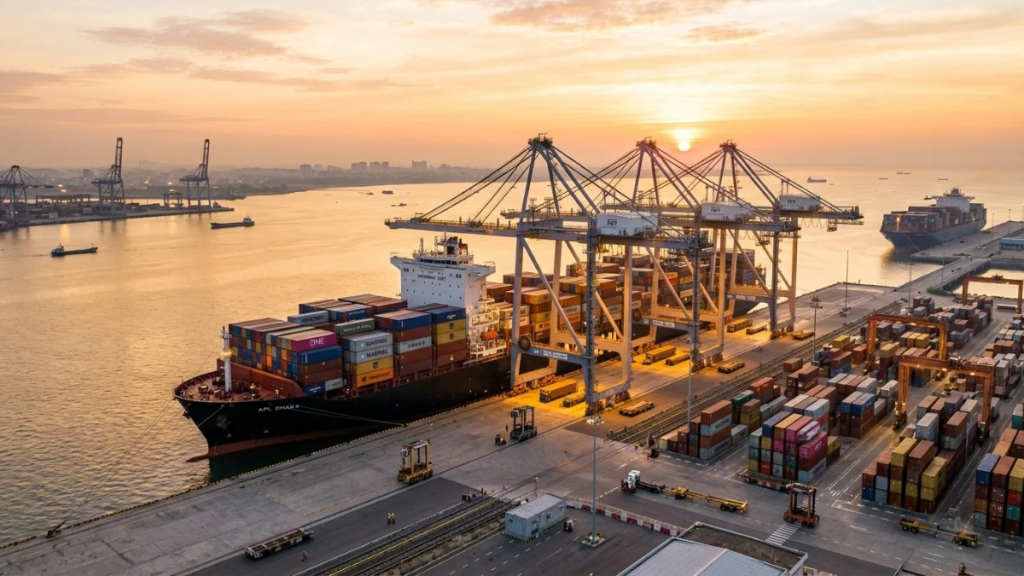
A massive wave of infrastructure modernization is sweeping across South Asian maritime corridors as regional governments approve multi-billion-dollar deep-water port expansions. Designed to accommodate ultra-large container vessels, these highly automated expansions are projected to double overall trade throughput by 2029, radically cutting container dwell times and breaking the region’s long-standing reliance on distant transshipment hubs.
Strategic Corridors Driving the Expansion
The logistics transformation spans multiple critical maritime corridors, each scaling up deep-sea infrastructure to capture the booming intra-Asia trade network:
- Matarbari Deep-Sea Port (Bangladesh): Backed by Japanese ODA, the Ministry of Shipping announced that extensive dredging has successfully completed 3.6 million cubic meters of channel excavation. Moving ahead on its civil works schedule through December 2029, its 16-meter draft will allow massive 8,200 TEU mother vessels to berth directly, eliminating current 3-to-7-day feeder vessel anchorage backlogs.
- Laldia Terminal & Chittagong (Bangladesh): A newly inked $550 million investment pipeline will construct a dedicated container terminal in Chattogram, scaling national handling capacity by roughly 40% and processing an additional 800,000 TEUs annually.
- Colombo West International Terminal (Sri Lanka): Operating at a record-breaking clip, Colombo handled a milestone 8.29 million TEUs. Phase 2 construction expanding the quay to 1,400 meters is actively scaling up capacity toward 3.2 million TEUs.
Comparative Overview of Regional Port Infrastructure Assets
The following table breaks down the key specifications of the newly integrated deep-water port installations currently entering operations across the South Asian subcontinent:
| Deep-Water Terminal | Target Operational Timeline | Added Annual Capacity (TEUs) | Maximum Operational Draft |
|---|---|---|---|
| Colombo West Terminal (CWIT) | Scaling up through 2026 | 3.2 Million | 20.0 Meters |
| Laldia Container Terminal | Fully Operational by 2029 | 800,000+ | Dedicated deep-water layout |
| Matarbari Deep-Sea Phase 1 | Implementation through 2029 | 8,200 TEU vessel rating | 16.0 Meters |
| Mongla Port Expansion | 42-Month Construction Phase | 350,000 | Upgraded 20,000 DWT berths |
Automation and Supply Chain Resilience
Advertisement

The competitive edge of these subcontinental expansions rests heavily on advanced automation. Shifting away from legacy manual terminal operations, developers are incorporating AI-driven yard optimization systems, automated stacking cranes, and smart digital checkpoints.
These technological overhauls shorten vessel turnaround loops, lower logistics costs for regional apparel and electronics exporters, and establish a resilient buffer against global trade volatility.